
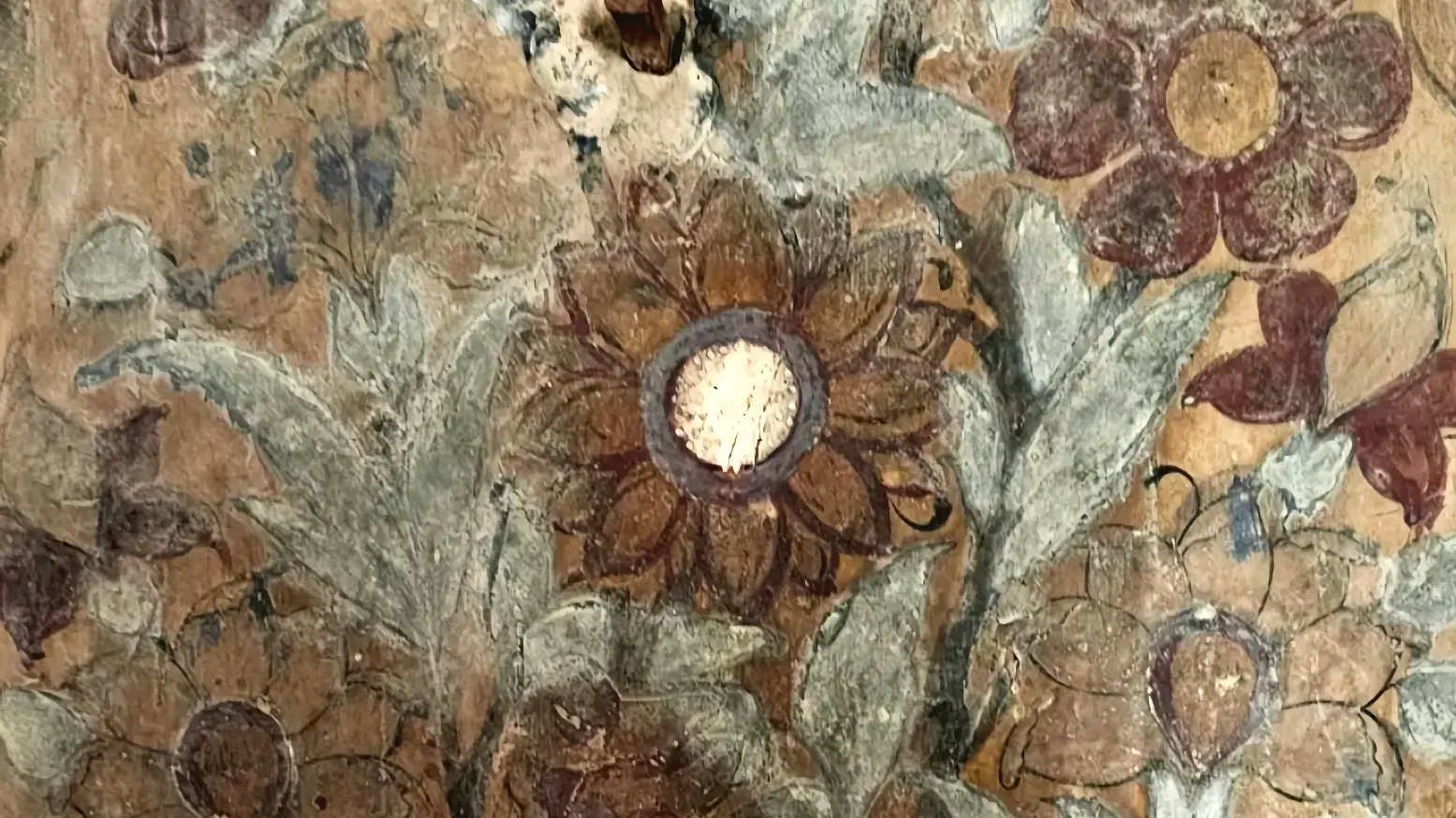
The mystery of the lost flower of Maharaja Duleep Singh begins in 1849. Maharaja Duleep Singh, the last Sikh sovereign ruler of Punjab, was forcibly removed by the British from the Lahore Fort at the age of about ten on December 21, 1849. He was the youngest son of Maharaja Ranjit Singh and was removed against his mother, Maharani Jind Kaur’s, wishes, who had been exiled earlier by the British.
The Legend of the Lost Flower of Maharaja Duleep Singh
Just before he departed the fort, legend has it that Maharaja Duleep Singh drew a flower in the Sheesh Mahal of the Lahore Fort. This is the story of finding that 175-year-old flower!
Historical Evidence of the Maharaja’s Painting
While searching historical sources on this myth, we came across the following account from an article published in the 1911 issue of the Journal of the Panjab Historical Society. It was titled Historical Note on the Lahore Fort and authored by J. Ph. Vogel. He writes:
“I wish to record an anecdote, which my old friend Faqir Qamruddin told me on the spot. He said that Dilip (vulgo Dhuleep) Singh, shortly before being taken to England, pointed out to him a particular flower in one of the panels of the back wall east of the central archway, and said with boyish pride: “Hazrat, ever remember that this flower was painted by me.”
Faqir Qumruddin (1827-1910) was the son of Faqir Nooruddin (died 1852). He was introduced to Maharja Duleep Singh (born 1838), and the two were well known to be good friends. Vogel, in his 1911 paper, listed his conversations with Faqir Qumruddin. There is no reason to doubt the accuracy of the account of Qumruddin.
It was now clear that the lost flower of Maharaja Duleep Singh was not a myth but a historical reality. The next step was to locate the flower, if it had survived the interventions of the British and Pakistani governments.
Before we headed out to the Sheesh Mahal, we consulted with eminent author and historian Fakir Aijazuddin. He is a descendant of Faqir Qumruddin. He, too, has heard of the flower, but his search for it was unsuccessful.
So with little hope, we went to the Sheesh Mahal at the Lahore Fort.
Searching for the Lost Flower in Lahore Fort
But first, a bit about the Sheesh Mahal at the fort. Completed by Mughal Emperor Shah Jahan around early 1630 as the residence of his Empress, it was called Shah Burj in Mughal times. In the Sikh era, it was called Samman and Musamman (Octagonal) Burj Badshahi. It was named Sheesh Mahal during the British era. The installation ceremonies of Maharaja Ranjit Singh, Maharaja Sher Singh, and Maharaja Duleep Singh were done here, as well as the 1849 transfer of power from the Sikh Rule to the British.
It served as the day residence of Maharaja Ranjit Singh. This is also where Maharaja Ranjit Singh died in 1839. The roof mirror work of the Sheesh Mahal is made of “Aleppo glass” from the Shah Jahan era and was repaired during the Sikh era.
Tracing the Steps of Maharaja Duleep Singh
Finding a flower inside this historical landmark was no easy task. We began from the central chamber, where the transfer of power from one king to another took place. Then, as per Qumruddin’s recollection, we focused on the back wall and moved east of the central archway. The small room just east of the central archway is an oddly shaped transition area devoid of any murals or paintings. The room just east of it is profusely painted with murals of trees, shrubs, and flowers.
The Discovery: Finding the 175-Year-Old Flower
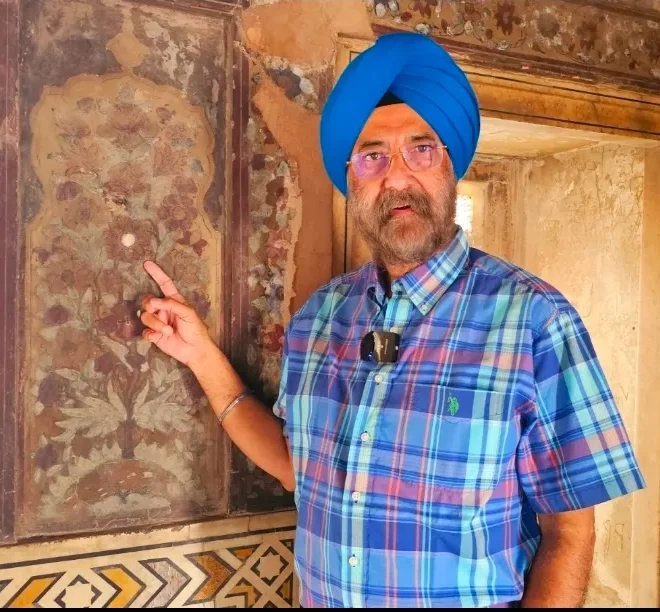
We began inspecting the room’s wall from west to east. Maharaja Duleep Singh was about 10 years old. For him to paint a flower on the wall, it would have to be at the height of our chests. So we focused on that area, moving left to right. The flowers on the left side of the room were many, and nothing stood out. Then came the opening in the wall with a marble screen. Just to the right of the screen was a big, beautiful flower.
As we looked at this flower, it dawned on us that it was at the right height and bigger than any other flowers in the room. The number of its petals was more than any other flower in the room. It is also the only flower in the room that has a shiny metallic center – the metal center may have been a gem placed at the flower’s center, but is now replaced with a shiny metal, possibly silver.
Then it dawned on us that this was the flower painted by Maharaja Duleep Singh before he left the fort in 1849. The myth of the lost flower of Maharaja Duleep Singh has now been proven to be historically true.
Why is the discovery of a flower painted over 175 years ago important?
It is one of the few remaining imprints of the last Sikh Maharaja of Punjab, who was banished from his homeland and never returned. The fact that this imprint of the Sikh era is still preserved at the Lahore Fort, despite the British converting the palace fort into an army garrison, is quite surprising.
For a society to move forward, we must acknowledge our past, and rarely do we get a chance to see something almost two centuries old that we can connect with as we work towards a better future.
The long-lost flower found again after over 175 years is a testament to discovering our roots despite the obstacles of borders, time, and nationalism.
by
Tarunjit Singh Butalia
Abdul Sami
Learn more about our work at Jeevay Sanjha Punjab.

Leave a Reply to Pargat Singh Cancel reply